
Latest audit record
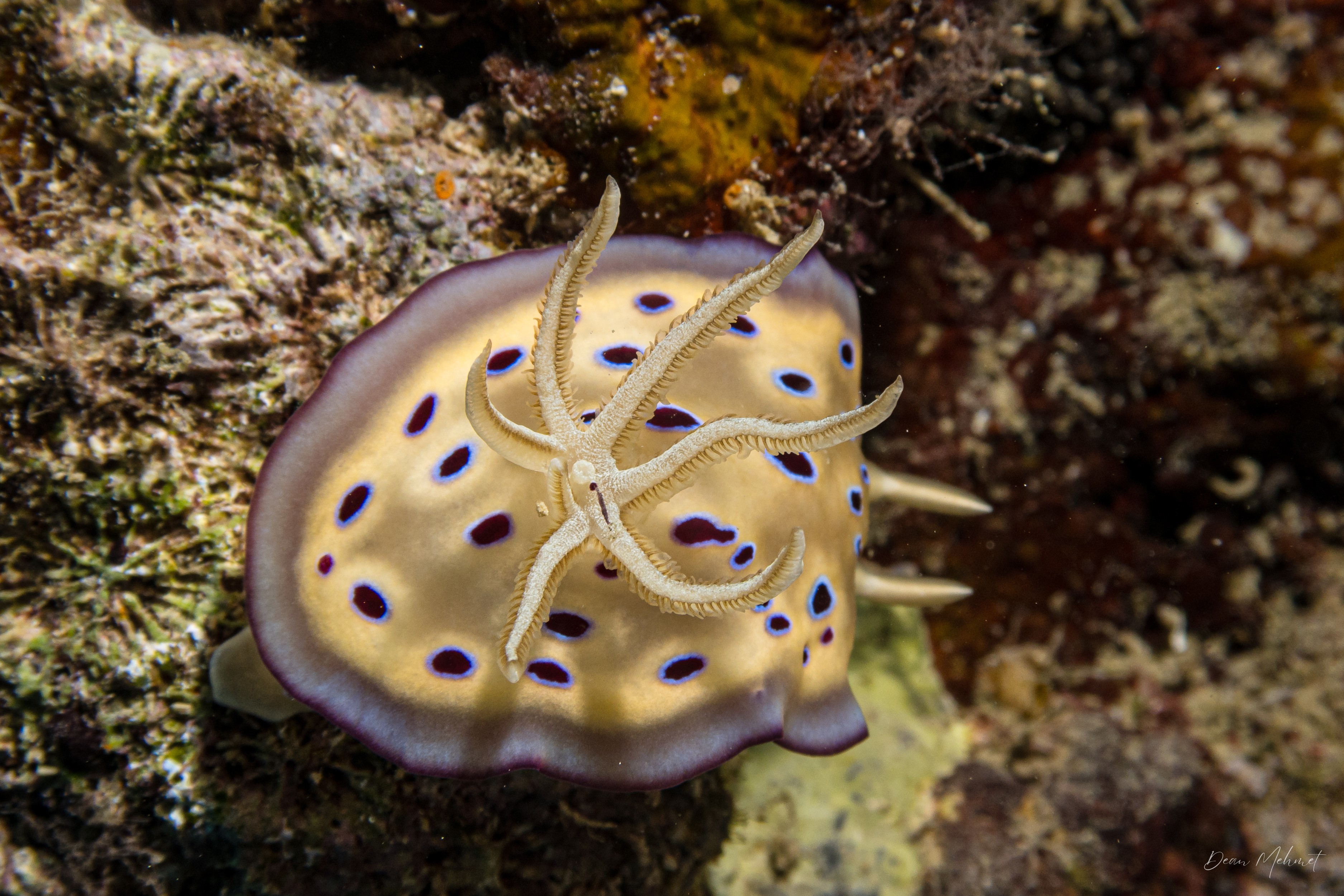
Conclusion: Goniobranchus kuniei
Reviewed by Codex identification research on Aug 29, 2026 · 97% reviewer confidence.
Reasoning recorded at review
- The animal is broad and oval with an ample, relatively low mantle skirt that widely overlaps the body.
- The mantle edge forms a broad compound border with multiple purple-violet zones and a pale creamy transition, not a single fine line.
- The cream-to-ochre dorsum carries predominantly separate solid dark violet-purple spots, each surrounded by a bright pale-blue, violet-white, or cream halo.
- Pale cream-to-yellow rhinophores and a large pale gill circlet are compatible supporting characters.
- The full dorsal view sharply resolves the broad compound purple skirt, individual haloed spots, and large pale gill circlet.
Alternatives considered
- Goniobranchus leopardus
Why plausible: A member of the same colour group with an ochre ground, purple marks, and a purple edge.
Comparison: G. leopardus should show only a fine purple edge and smaller marks more often organized into hollow rings or multi-spot leopard patterns; neither combination is visible here.
- Hypselodoris tryoni
Why plausible: Shares solid dark marks with pale halos and colour-group similarity.
Comparison: H. tryoni should be high, elongate, and narrow with reduced mantle overlap and only a fine violet edge, contrary to the broad low multi-banded mantle visible here.
- Goniobranchus geminus / Goniobranchus tritos
Why plausible: Indian Ocean colour-group analogues can share a broad chromodorid body and haloed dorsal spots.
Comparison: A specimen-backed comparison of the full marginal band order and internal anatomy or molecular data would be required; locality is supporting context only and is not used to exclude them by itself.
Evidence limits & sources +−
- • No voucher anatomy or molecular sequence is available, so the photographic conclusion remains probable rather than confirmed.
- • Underwater lighting changes cream, ochre, violet, and blue hues; the decision therefore relies on body form, relative band widths, and spot construction.
- • The ventral mantle and foot pattern is not completely exposed in this frame.


