
Latest audit record
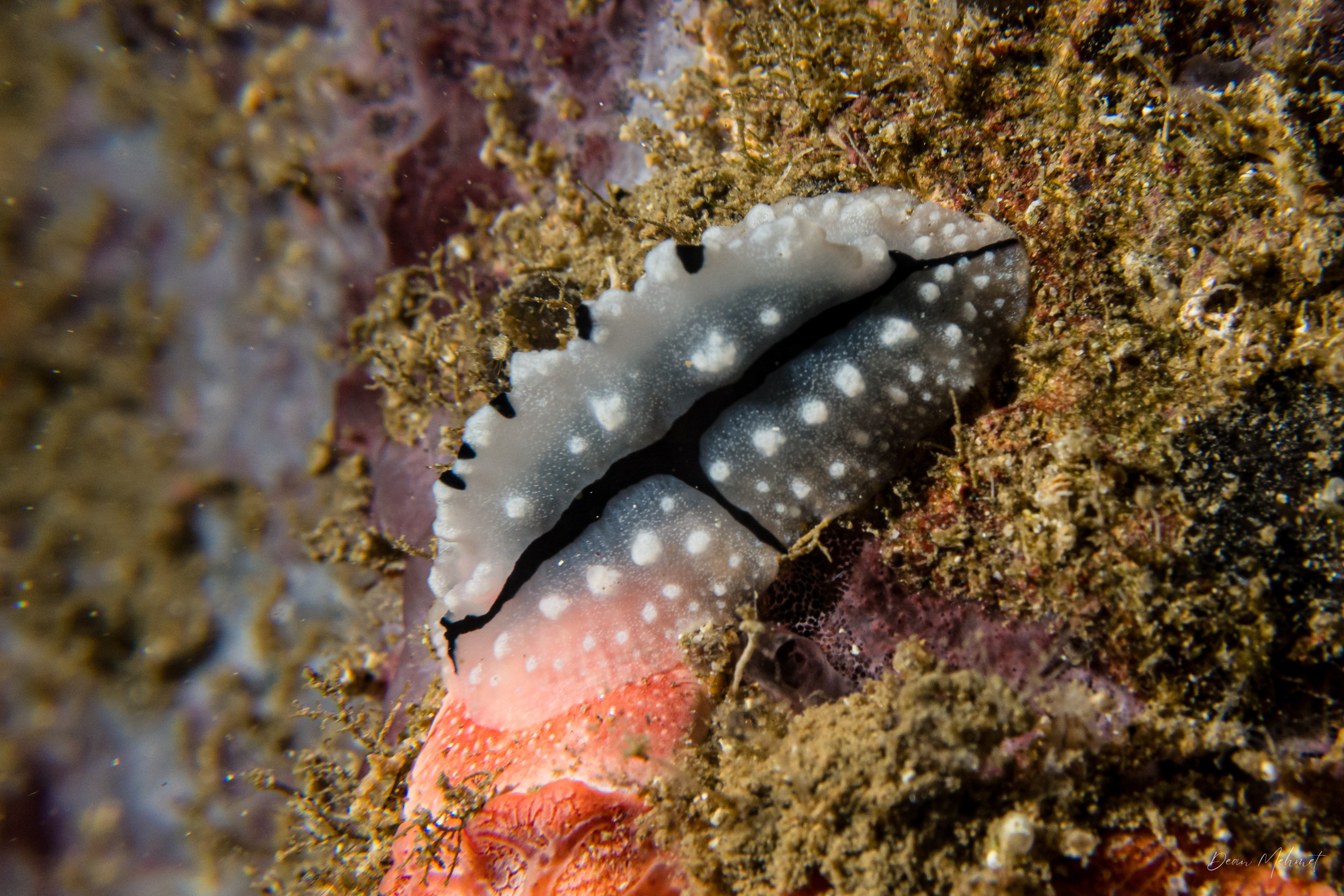
Conclusion: Phyllidiopsis shireenae
Reviewed by Codex identification research on Aug 27, 2026 · 95% reviewer confidence.
Reasoning recorded at review
- Elongate, high-bodied animal with one continuous raised mid-dorsal crest
- Very pale pink to white dorsal ground
- Broad black band encircles the raised central region
- Anterior, posterior and lateral black lines radiate from the encircling band toward the mantle edge
- Numerous small rounded mantle-skirt tubercles and sparser larger simple-to-angular tubercles over the crest
- The complete visible combination agrees with the published Phyllidiopsis shireenae accounts
Alternatives considered
- Phyllidiopsis krempfi / P. pipeki / P. fissurata
Why plausible: Pink-and-black congeners with prominent tubercles
Comparison: They are expected to have compound or multi-compound tubercles and black-and-pink rhinophores; a clear rhinophore view would strengthen exclusion
- Phyllidiopsis gemmata
Why plausible: Pale ridged congener
Comparison: It is expected to show three tuberculate ridges and black rhinophores rather than one tall continuous median crest
Evidence limits & sources +−
- • Pale salmon-pink rhinophores are not genuinely visible in this frame
- • Ventral white foot and oral tentacles, plus the reported ventral black band, are not visible
- • No specimen-level internal anatomical or molecular evidence
Foundational Phyllidiidae revision ↗Primary paper · Brunckhorst 1993 · Phyllidiopsis shireenae account, pp. 66–67 and Plate 8BPapua New Guinea specimen redescription ↗Primary paper · Domínguez, Quintas & Troncoso 2007 · Phyllidiopsis shireenae account and Fig. 7Integrative Phyllidiidae context ↗Primary paper · Papu et al. 2022 · Phyllidiopsis clade and comparative external characters


