
Latest audit record
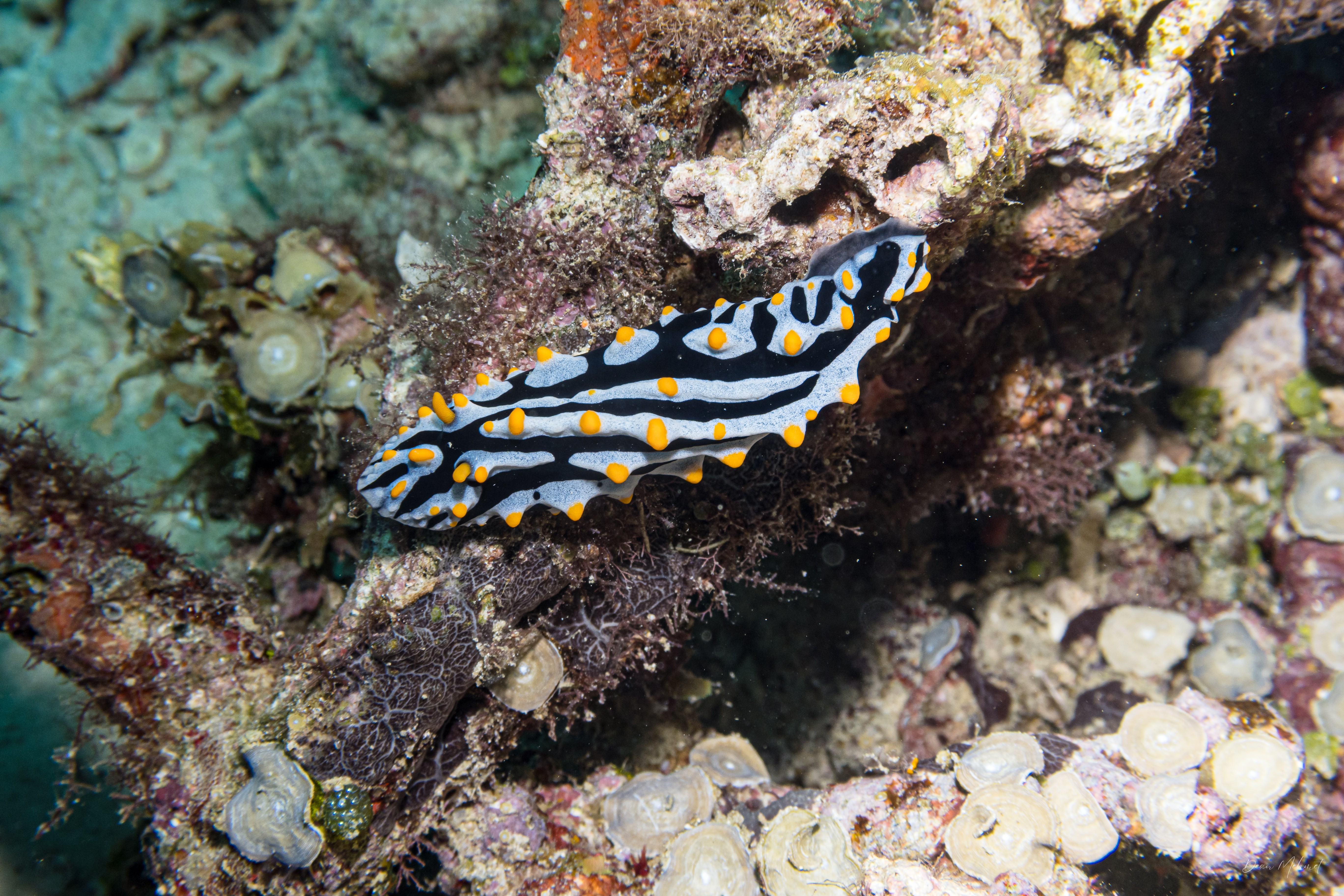
Conclusion: Phyllidia varicosa
Reviewed by Codex identification research on Aug 29, 2026 · 86% reviewer confidence.
Reasoning recorded at review
- Elongate adult-like body with multiple substantial longitudinal blue-grey tuberculate ridges
- Broad black longitudinal bands and shorter branching black marks separate the ridges
- Numerous ridge tubercles have yellow-orange caps
- The visible lamellate rhinophore is yellow-orange
- The combined dorsal form falls within the varied Phyllidia varicosa series illustrated by Papu et al. (2022)
Alternatives considered
- Phyllidia haegeli
Why plausible: Papu et al. show that P. haegeli can closely mimic P. varicosa dorsally, including black longitudinal lines, blue-grey ridges and yellow-capped tubercles.
Comparison: A clearly documented dorsal versus ventral anal opening is needed; this frame does not expose the anal position unambiguously.
- Phyllidia alyta
Why plausible: P. alyta also combines longitudinal black lines with linearly arranged orange tubercles and a dark sole line.
Comparison: The photographed animal has more developed broad ridges and branching black fields, and P. alyta is reported principally from the western Indian Ocean; a ventral view and expert comparison would be needed to revive this alternative.
Evidence limits & sources +−
- • Anal opening position is not unambiguously visible
- • No ventral view of the foot sole or oral tentacles
- • No measured live body length
- • No rhinophoral lamella count, internal anatomy or DNA


