
Latest audit record
Conclusion: Hypselodoris cf. whitei
Reviewed by Codex identification research on Sep 5, 2026 · 82% reviewer confidence.
Reasoning recorded at review
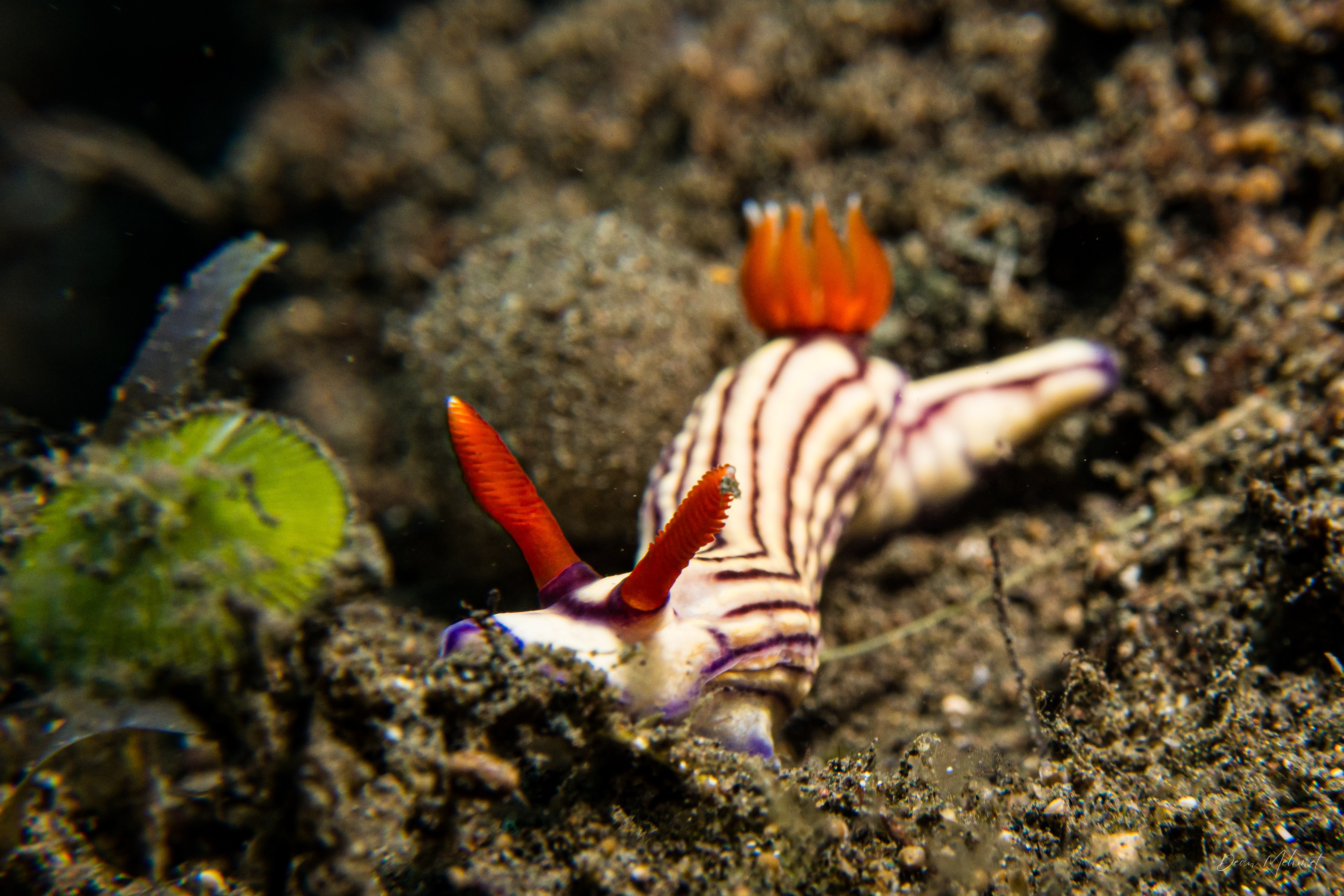
- The mantle is cream-white with a narrow purple edge
- Approximately five purple longitudinal lines are visible on the dorsum
- Several lines curve and cross around the rhinophores and gill pocket
- The rhinophores and gill plume are orange-red
- Very small pale tips may be present on some appendages but are not resolved consistently
- The five-line western-Pacific pattern supports H. whitei as the closest named match
Alternatives considered
- Hypselodoris maridadilus
Why plausible: This close relative also has five purple lines and orange-red appendages; uniform orange appendages would favour it over H. whitei.
Comparison: A sharp true-colour macro view must establish whether the rhinophores and upper gill edges carry opaque white pigment; anatomy or DNA may still be required.
- Hypselodoris emma
Why plausible: H. emma shares the pale ground, purple lines and orange-red appendages.
Comparison: H. emma normally has three principal purple lines with diffuse brown fields, whereas this animal shows roughly five; a clean dorsal frame would confirm the line count.
Evidence limits & sources +−
- • Sharp dorsal macro detail of both rhinophore apices and the upper inner edges of the gills
- • True-colour confirmation that any pale tips are opaque white pigment rather than glare or blur
- • Anatomy or DNA for a definitive H. whitei versus H. maridadilus assignment if external tips remain ambiguous
Reading between the lines: Hypselodoris revision ↗Primary paper · Epstein et al. (2019), Zoological Journal of the Linnean Society 186: 116-189 · H. maculosa subclade and colour-pattern discussion, especially pp. 180-183 · checked Sep 5, 2026 · full frame suppliedContribution: The revision retains H. whitei and H. maridadilus as distinct close relatives and records their line-pattern clade while warning that convergent colour patterns require subtle complete comparisons.Original H. emma and H. maridadilus comparative treatment ↗Primary paper · Rudman (1977), Zoological Journal of the Linnean Society 61: 351-397 · H. lineata colour-group accounts and comparisons · checked Sep 5, 2026 · full frame suppliedContribution: Five purple lines and orange-red appendages place the animal in the whitei-maridadilus comparison rather than the three-line H. emma pattern.WoRMS current name check ↗Taxonomic register · MolluscaBase via WoRMS, AphiaID 560037 · Hypselodoris whitei taxon record · checked Sep 5, 2026Contribution: WoRMS lists Hypselodoris whitei (A. Adams & Reeve, 1850) as accepted; it also retains H. maridadilus separately. The register does not identify this photograph.


